The Do-olls That Will Talk
It's Beginning to Look a Lot Like Christmas
Why does Perry Como sing "dolls" early in It’s Beginning to Look a Lot Like Christmas ?
Have a listen to these two renditions of the Christmas classic composed by Meredith Willson. Pay particular attention to where the emphasis lands when singing the word "dolls".
Bublé: On the Beat
Let’s start with one of the most famous contemporary versions. Bublé, smooth as ever, sits squarely on the beat.
Here is the corresponding notation. Note the small triplet adjustment at the start: it mainly exists to make “A pair of” scan cleanly in MuseScore.
Como and the Fontane Sisters: The Canonical Version
Now for the original. Here, "dolls" arrives slightly before the bar. The first time around it’s sung by the Fontane Sisters; keep listening to hear Como’s even more pronounced offset, or skip ahead to 1:54 if you’re impatient.
In measure six, the word "dolls" enters late: on the final triplet subdivision of the bar, effectively a pickup into the next measure.
Playhead links to the versions shown so far:
Listen: Contemporary Bublé (1:16) · Canonical Fontane Sisters (0:45) · Canonical Como (1:54) · Silence Music
Audio Analysis
We can now zoom in on the Como recording and inspect the audio itself. When aligned against a click track, a subtle ritardando becomes visible: the tempo eases from roughly 117 BPM down toward 115 BPM across this phrase.
The word "do-olls" appears clearly in the waveform as a distinctive two-humped shape just after the five-second mark. The initial syllable "do-" does not coincide with a beat; instead, it sits almost exactly midway between beat 4 of measure six and beat 1 of measure seven.
This places the vocal entrance on the final eighth note of the bar (see measure nine). In other words, the notation captures the idea of the rhythm, but the performance itself leans even further forward than a strict triplet reading would suggest.
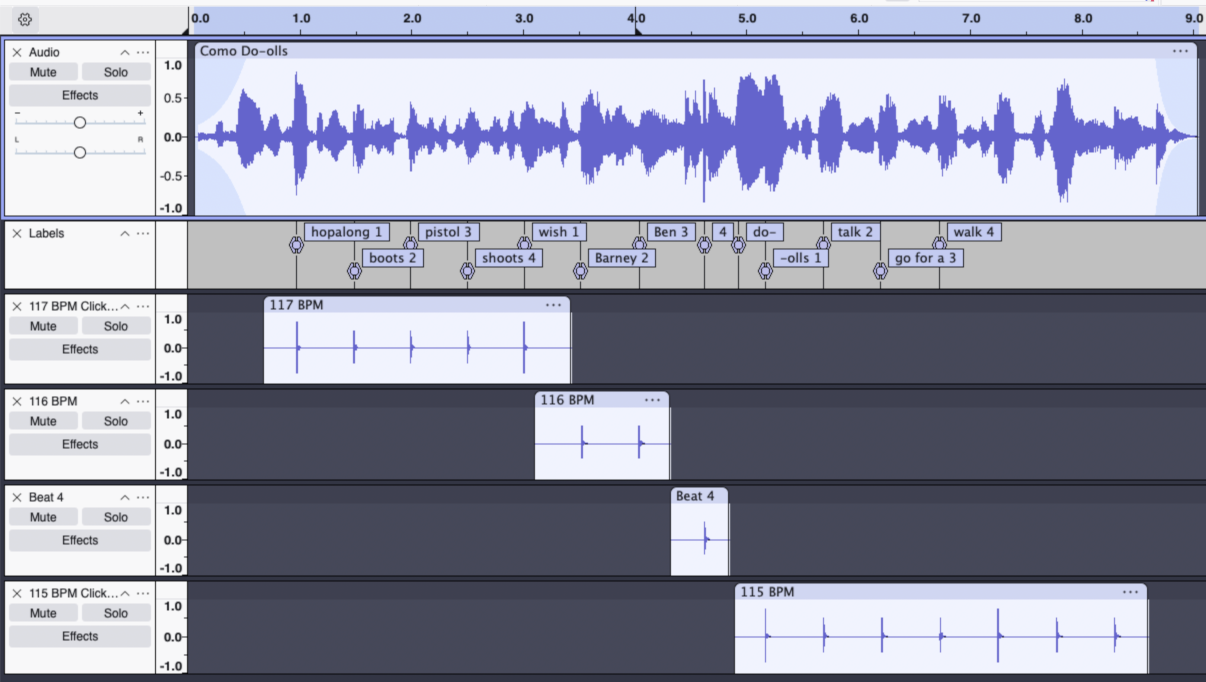
Here is the section in question, with a playback interface:
The adapted notation looks like this:
However, it does not sound correct in playback. What to do?
The Easy Fix: Swing
There is, of course, a simpler solution: turn on swing. With swing enabled, the notation falls into place. The pickup can be written in straight eighths, and the “do-” syllable comfortably sits on an eighth note. The phrases “wish of” and “hope for” still require a dotted-eighth–sixteenth pattern to preserve the feel, but the overall rhythm now aligns naturally with the performance.
Pushing Forward
The next step is to listen to a variety of recordings and see which emphasis style dominates. But a distraction appeared! so I’m off to learn more: reharmonization of the piece .